

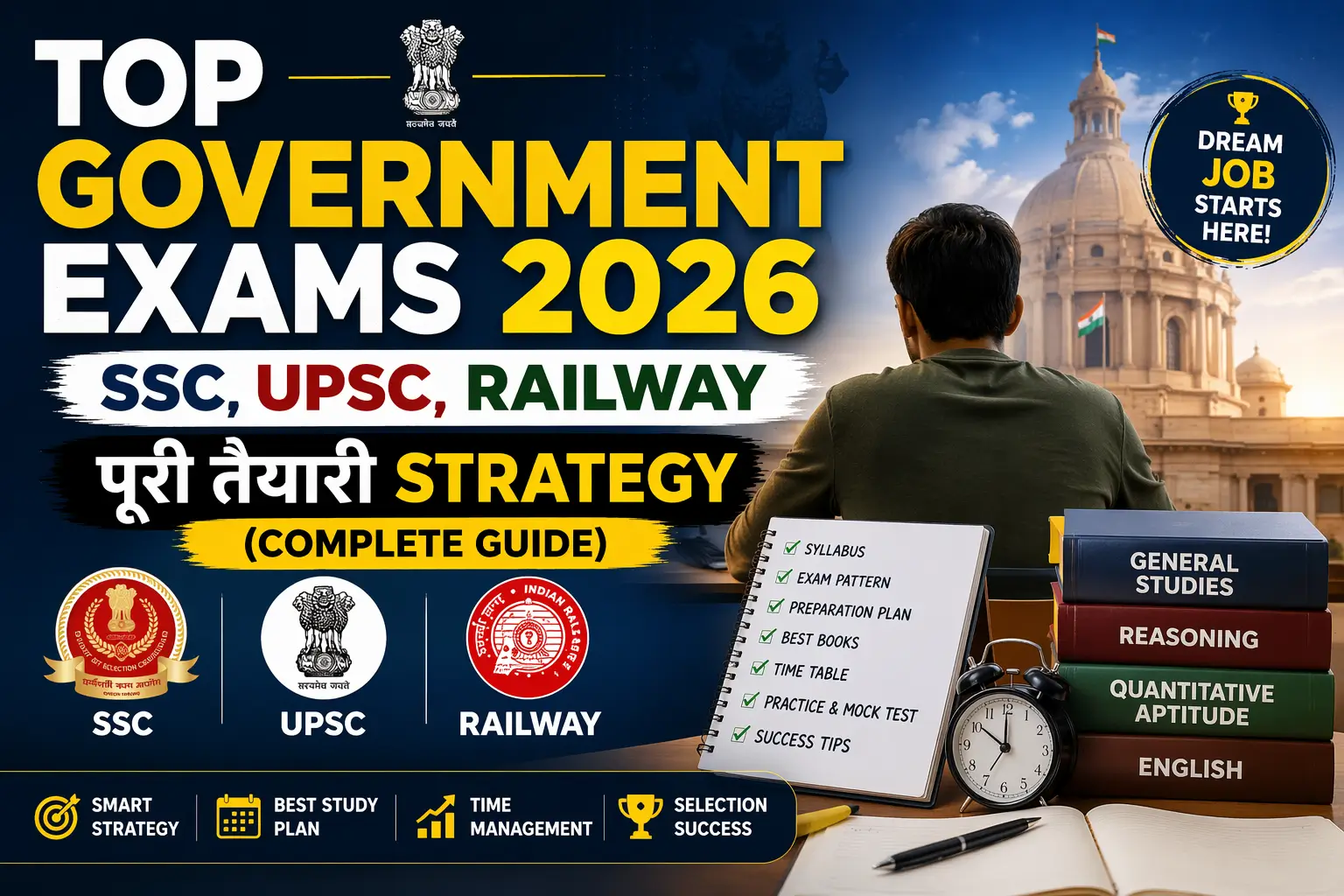
UPSC Civil Services Examination भारत की सबसे कठिन परीक्षा है - लेकिन “कठिन” का मतलब “असंभव” नहीं है। हर साल 900-1,000 candidates IAS, IPS, IFS जैसी services में select होते हैं - और उनमें से अधिकतर ने structured preparation की थी, इसीलिए success मिली।
Prelims क्लियर करना पहला और सबसे critical step है। यह guide आपको UPSC Prelims 2026 के लिए exactly वो strategy देगी जो काम करती है।
TL;DR
- UPSC Prelims 2026 में GS Paper-I (200 marks) merit-based, CSAT Paper-II qualifying (33%)
- History, Polity, Geography, Environment - सबसे high-weightage subjects
- NCERT → Standard Books → PYQ → Mock Tests - यही proven sequence है
- Current Affairs (last 12 months) लगभग 20-25 questions cover करता है
- Negative marking ⅓ है - educated guessing allowed, blind guessing avoid करें
- UPSC Complete Strategy में pillar article में और details हैं
UPSC Prelims 2026 - Exam Structure
GS Paper-I (200 Marks, 2 Hours)
- 100 objective questions × 2 marks = 200 marks
- ⅓ negative marking per wrong answer
- Covers: History, Geography, Polity, Economy, Environment, Science, Current Affairs
CSAT Paper-II (200 Marks, 2 Hours - Qualifying)
- 80 objective questions × 2.5 marks = 200 marks
- Minimum qualifying: 66 marks (33%)
- Covers: Reading Comprehension, Logical Reasoning, Basic Maths, Decision Making
UPSC Prelims GS Paper-I - Subject-wise Analysis
1. History (15-20 Questions Expected)
UPSC में History सबसे consistently high-weightage subject है।
Ancient History:
- Indus Valley Civilization
- Vedic Period - Early और Later
- Buddhism और Jainism
- Mauryan Empire (Ashoka focus)
- Gupta Period - Golden Age
- Best Source: Old NCERT Class 11 - R.S. Sharma
Medieval History:
- Delhi Sultanate और Mughal Empire
- Bhakti और Sufi Movements
- Vijayanagara Empire
- Provincial Kingdoms
- Best Source: Satish Chandra (Old NCERT Class 11)
Modern History (Most Important):
- 1857 Revolt
- Indian National Congress और freedom movement
- Gandhi era - Non-Cooperation, Civil Disobedience, Quit India
- Revolutionary movements
- Partition और Independence
- Best Source: Bipin Chandra - “India’s Struggle for Independence” (selected chapters)
Art & Culture:
- Architecture styles - Temple, Mosque, Mughal
- Classical dance forms, Music, Paintings
- World Heritage Sites in India
- Best Source: Nitin Singhania - “Indian Art and Culture”
Strategy:
- NCERT पहले completely पढ़ें
- PYQ में देखें - कौन से specific topics frequently आते हैं
- Art & Culture से हर साल 3-5 questions guaranteed आते हैं
2. Geography (15-20 Questions)
Physical Geography (World):
- Earth’s structure, Rocks, Weathering
- Landforms - Mountains, Plateaus, Plains, Coasts
- Climate - Types, Factors, Monsoon
- Ocean currents, Coral Reefs, Mangroves
- Earthquakes और Volcanoes
- Best Source: Goh Cheng Leong + NCERT Class 11
Indian Geography:
- Physical features - Himalayas, Plains, Peninsular Plateau
- Rivers, Lakes, Drainage System
- Soil types, Natural Vegetation
- Climate, Monsoon patterns
- Economic Geography - Agriculture, Industries, Minerals
- Best Source: NCERT Class 11 India Physical Environment
Human Geography:
- Population, Migration, Urbanization
- Human Development Index (HDI)
- World economic geography basics
- Best Source: NCERT Class 12 Human Geography
Map Work:
- Important rivers, mountains, passes
- State capitals, important cities
- International boundaries
Strategy:
- Atlas ख़रीदें और उसके साथ पढ़ें
- Current affairs में geography application - floods, cyclones, etc.
- Map questions में toppers को advantage होता है
3. Indian Polity (15-20 Questions)
यह UPSC का सबसे scoring subject है। Laxmikanth की book पूरी पढ़ लेने से 12-15 questions sure होते हैं।
Important Topics:
- Constitution - Making, Preamble, Features
- Fundamental Rights और Duties
- Directive Principles (DPSP)
- Parliament - Structure, Powers, Sessions, Bills
- President, Vice President, PM, Cabinet
- Supreme Court और High Courts
- Federalism - Centre-State Relations
- Emergency Provisions
- Constitutional Bodies (CAG, UPSC, Election Commission)
- Local Self Government - 73rd और 74th Amendments
- Constitutional Amendments
Current Issues:
- Recent bills passed in Parliament
- Supreme Court major judgments
- Constitutional bodies में recent appointments
Best Source: M. Laxmikanth - “Indian Polity” (4th या 5th Edition)
Strategy:
- Laxmikanth को chapter-wise पढ़ें, रटें नहीं - समझें
- PYQ में Polity से हर साल 15-18 questions आते हैं
- Recent constitutional news follow करें
4. Indian Economy (10-15 Questions)
Basics:
- GDP, GNP, NNP - concepts
- Inflation types, Causes, Measures
- Banking - RBI, Monetary Policy, CRR, SLR, Repo Rate
- Budget - Fiscal Policy, Deficit types
- Taxation - Direct और Indirect taxes, GST
Schemes and Programs:
- Government schemes - PM Kisan, Jal Jeevan Mission, Ujjwala
- Five Year Plans का history (discontinued but asked)
- NITI Aayog, Planning Commission
International Economy:
- IMF, World Bank, WTO
- India’s trade, BOP, Current Account Deficit
- FDI, FII
Best Source: Ramesh Singh - “Indian Economy” (Selected Chapters) + Economic Survey Highlights
Strategy:
- Economy current affairs से 5-8 questions हर साल
- Budget 2026 ज़रूर पढ़ें - कम से कम highlights
- Technical concepts को conceptually समझें - definitions नहीं रटें
5. Environment और Ecology (10-15 Questions)
यह section last 5 years में increasingly important हो गया है।
Key Topics:
- Ecosystem - Types, Food Chain, Energy Flow
- Biodiversity - Hotspots, Threatened Species, Conservation
- Climate Change - Greenhouse Effect, Global Warming, Kyoto, Paris Agreement
- Pollution - Types, Causes, Effects, Measures
- Wildlife Protection Act, Forest Act
- National Parks, Sanctuaries, Biosphere Reserves, Tiger Reserves
- International organizations - UNEP, IUCN, CBD
- Ramsar Sites in India
Current Affairs Environment:
- Recent IUCN Red List updates
- New National Parks या Sanctuaries declared
- Climate summits - COP meetings
- India’s environmental policies
Best Source: Shankar IAS Environment Book + Current Affairs
6. General Science (10-12 Questions)
Physics:
- Motion, Force, Work, Energy, Power
- Sound, Light - reflection, refraction
- Electricity basics
Chemistry:
- Periodic Table, Chemical Bonding
- Acids, Bases, Salts
- Important chemicals and their uses
Biology:
- Cell Theory, Human Body Systems
- Diseases - Bacterial, Viral, Parasitic
- Nutrition, Vitamins, Deficiency diseases
- Biotechnology basics - GMO, CRISPR
Science & Technology (Current):
- Space missions (ISRO - Chandrayaan, Gaganyaan updates)
- Defence technology - missiles, submarines
- AI, Blockchain, Cybersecurity basics
Best Source: NCERT Class 8-10 Science + Lucent General Science
7. Current Affairs (20-25 Questions)
Current Affairs UPSC Prelims का सबसे dynamic section है।
Sources:
- Primary: The Hindu (daily) + PIB (Press Information Bureau)
- Secondary: Indian Express, Business Standard
- Monthly Compilation: Vision IAS Monthly Current Affairs
Categories to Cover:
- National events - Government decisions, Laws
- International relations - Bilateral visits, Treaties
- Economy - RBI decisions, Major indices, Rankings
- Environment - Reports by UNEP, WWF, etc.
- Science & Tech - ISRO, DRDO missions
- Sports - Major tournaments, India’s performance
- Awards - Bharat Ratna, Padma, Nobel, Man Booker
Strategy:
- Daily 1-2 hours The Hindu का editorial + important news
- हर weekend - weekly current affairs compilation review करें
- PIB daily press releases को 10 minutes में scan करें
CSAT Paper-II Preparation
CSAT qualifying है (33% minimum), लेकिन ignore मत करें।
Reading Comprehension
- Long passages - 300-400 words
- Questions - inference, main idea, vocabulary
- Strategy: Daily English newspaper reading speed बढ़ाएं; practice passages solve करें
Logical Reasoning
- Syllogisms, Statements & Conclusions
- Coding-Decoding (simpler than SSC)
- Analytical Reasoning
- Strategy: R.S. Aggarwal Verbal Reasoning selected topics
Basic Numeracy (Class 10 Level)
- Percentage, Profit-Loss, Ratio
- Data Interpretation - Tables, Graphs
- Strategy: Class 10 NCERT Maths + Tata McGraw Hill CSAT book
Decision Making
- Administrative scenarios
- Ethical situations
- Strategy: यह reasoning-based है - no separate preparation needed; practice करें
6-Month UPSC Prelims Study Plan
Month 1: Foundation (NCERT)
| Week | Tasks |
|---|---|
| 1 | History NCERT (6-12) |
| 2 | Geography NCERT (6-12) |
| 3 | Polity NCERT (8-12) |
| 4 | Economy NCERT + Science NCERT |
Daily: 8-10 hours | Current Affairs: 1 hour daily
Month 2-3: Standard Books
- Laxmikanth - Indian Polity (complete)
- Bipin Chandra - Modern History (complete)
- Shankar IAS - Environment (complete)
- Ramesh Singh - Indian Economy (selected chapters)
- GC Leong - Physical Geography (selected chapters)
Month 4: Revision + PYQ
- NCERT revision
- Previous Year Questions 2011-2025 solve करें
- Note करें - कौन से topics most frequently asked हैं
Month 5: Mock Tests + Current Affairs
- Weekly Full Mock Tests (100 questions, 2 hours)
- Daily current affairs revision
- Weak areas identify करें और उन पर focus करें
Month 6: Final Revision
- Daily 2 mocks
- Flash cards और short notes की revision
- Current Affairs - last 6 months intensive revision
- Rest और health का ध्यान रखें
UPSC Prelims में Attempt Strategy
Positive Marking: +2 per correct Negative Marking: -0.667 per wrong (⅓ of 2)
When to Attempt:
- Sure: अगर 80%+ confident हैं → attempt करें
- Educated Guess: अगर 2 options eliminate कर सकते हैं → attempt करें (expected value positive)
- Total Guess (1 in 4): 25% accuracy = negative expected value → SKIP
Section-wise Target (for ~110+ score):
| Section | Target Questions | Target Marks |
|---|---|---|
| History | 14-16/18 | 28-32 |
| Polity | 12-14/15 | 24-28 |
| Geography | 12-14/15 | 24-28 |
| Environment | 8-10/12 | 16-20 |
| Economy | 8-10/12 | 16-20 |
| Science | 8-10/10 | 16-20 |
| Current Affairs | 14-16/20 | 28-32 |
Common Mistakes in UPSC Prelims
❌ NCERT skip करना - Foundation weak होगी तो standard books नहीं समझ आएंगी
❌ CSAT ignore करना - हर साल कुछ students CSAT में fail होते हैं
❌ Mock tests नहीं देना - Time management exam में सीखना बहुत महंगा पड़ता है
❌ Optional subject early decide करना - Prelims के बाद Mains की सोचें
❌ Social media पर time waste - Toppers का exam के 6 months पहले social media बंद या limited
Resources और Tools
| Resource | Use |
|---|---|
| Vision IAS Test Series | Best for UPSC Prelims mock tests |
| Insights IAS | Free tests + current affairs |
| UPSC Pathshala | YouTube - free lectures |
| The Hindu | Daily newspaper |
| PIB.gov.in | Government press releases |
Conclusion
UPSC Prelims 2026 clear करने के लिए आपको breadth और depth दोनों चाहिए - हर subject को touch करना है, लेकिन high-weightage topics पर extra time देना है।
याद रखें: Prelims filter है, Mains select करता है। Prelims में ज़रूरत है marks लाने की, इसलिए accuracy और smart guessing strategy ज़रूरी है।
और resources: